The Authentic Cornish Pasty Recipe Miners Ate For Lunch (Meat & Potato)
The Authentic Cornish Pasty Recipe Miners Ate For Lunch (Meat & Potato)
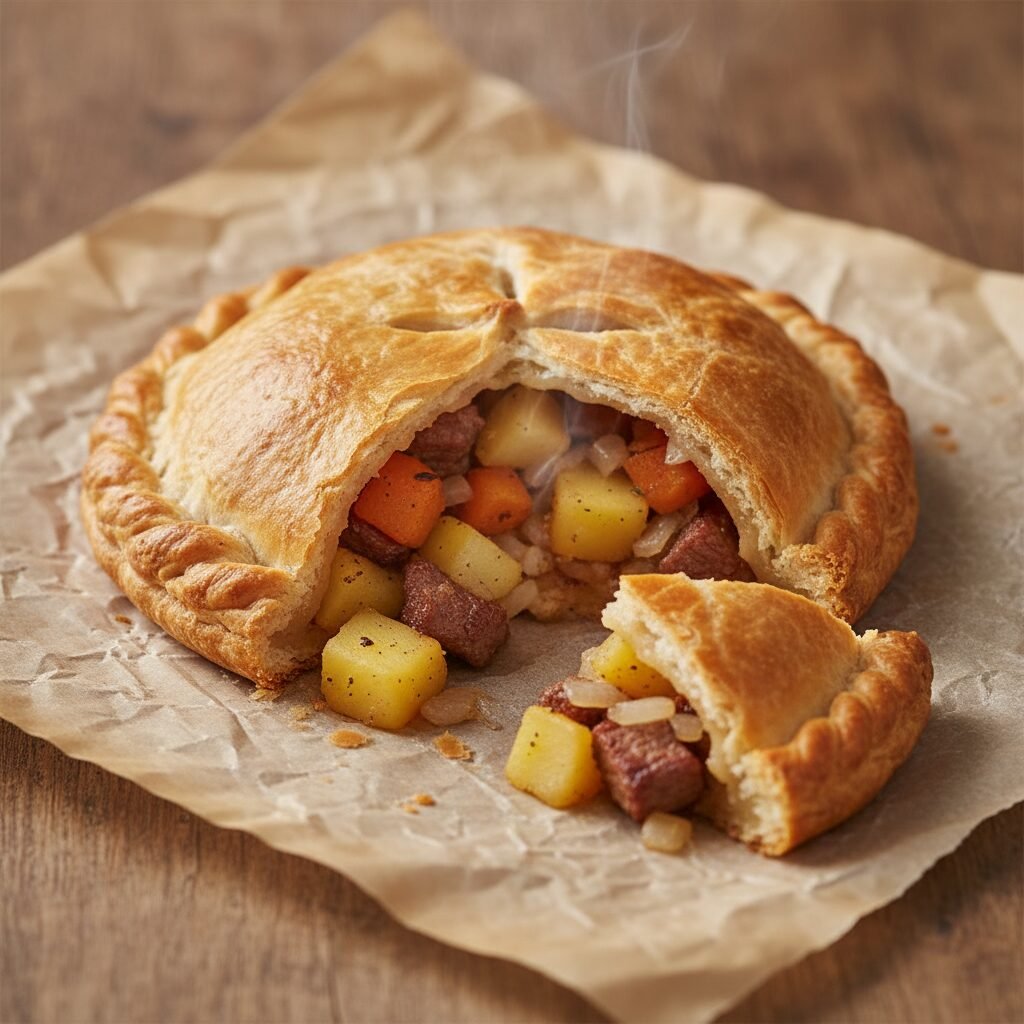
The Cornish pasty is more than just a savory pie; it’s a piece of culinary history, a symbol of Cornwall’s mining heritage, and a protected food icon. Granted Protected Geographical Indication (PGI) status in 2011, a genuine Cornish pasty must be made in Cornwall and adhere to a strict recipe. Its story begins deep underground, in the tin mines of the 18th century. Wives and mothers would bake these all-in-one meals for their husbands and sons to take to work. The pasty’s distinctive D-shape and thick, crimped crust served a practical purpose: it was a portable lunchbox, with the crust acting as a handle to be held by dirty, arsenic-laced hands and then discarded. The hearty filling of beef, potato, swede, and onion provided the much-needed calories for a day of hard labor. This recipe is a tribute to that tradition—a robust, flavorful, and truly authentic Cornish pasty that transports you to the rugged cliffs and historic mining towns of England’s southwestern tip.
45 minutes (plus 30 minutes pastry resting time)
55 minutes
1 hour 40 minutes
4 large pasties
Main Course
Baking
British (Cornish)
Standard
Why You’ll Love This Recipe
- Follows the traditional PGI-protected ingredient list
- Creates a shortcrust pastry that is both flaky and strong enough to hold the filling
- Features a classic, hearty filling of beef skirt, potato, swede, and onion
- Perfect for a satisfying lunch, dinner, or picnic
- A complete, all-in-one meal with a rich history
Equipment You’ll Need
- Large mixing bowl
- Rolling pin
- Sharp knife
- Cutting board
- 2 large baking sheets
- Parchment paper
- Pastry brush
Ingredients
- For the Pastry:
- 500g (4 cups) strong bread flour, plus extra for dusting
- 1 teaspoon salt
- 125g (1/2 cup + 1 tbsp) cold lard, diced
- 125g (1/2 cup + 1 tbsp) cold unsalted butter, diced
- 175ml (3/4 cup) ice-cold water
- For the Filling:
- 400g (approx. 14 oz) good quality beef skirt or chuck steak, finely diced
- 1 large onion (about 200g), finely chopped
- 1 large Maris Piper or other floury potato (about 250g), peeled and thinly sliced or diced
- 150g (1 cup) swede (rutabaga), peeled and thinly sliced or diced
- 30g (2 tbsp) unsalted butter
- 1 teaspoon coarse sea salt
- 1/2 teaspoon freshly ground black pepper
- 1 egg, beaten with a splash of milk (for the egg wash)
Instructions
- Step 1: Make the Pastry. In a large bowl, mix the flour and salt. Add the cold, diced lard and butter. Using your fingertips, rub the fats into the flour until the mixture resembles coarse breadcrumbs. Avoid overworking it; some small lumps of fat are desirable for a flaky texture.
- Step 2: Form the Dough. Make a well in the center of the flour mixture and gradually pour in the ice-cold water, mixing with a knife until a rough dough begins to form. Bring the dough together with your hands, knead gently for just a minute until it’s smooth, then shape it into a disc. Wrap in plastic wrap and refrigerate for at least 30 minutes.
- Step 3: Prepare the Filling. While the pastry rests, prepare your filling ingredients. In a large bowl, combine the diced beef, chopped onion, diced potato, and diced swede. Season generously with the salt and plenty of black pepper. Toss everything together to ensure an even distribution of ingredients and seasoning.
- Step 4: Assemble the Pasties. Preheat your oven to 200°C (400°F). Line two baking sheets with parchment paper. Divide the chilled pastry into four equal pieces. On a lightly floured surface, roll one piece into a circle about 25cm (10 inches) in diameter, roughly the size of a dinner plate.
- Step 5: Fill the Pastry. Layer one-quarter of the filling mixture onto one half of the pastry circle, leaving a 2cm (1-inch) border. The traditional layering method is potatoes, swede, and onion on the bottom, with the beef on top. This allows the meat juices to flavor the vegetables as it cooks. Dot the top of the filling with a small knob of butter.
- Step 6: Seal and Crimp. Brush the pastry border with a little water or the egg wash. Fold the empty half of the pastry over the filling to create a ‘D’ shape. Press the edges firmly together to seal. To crimp, start at one corner and use your thumb and forefinger to repeatedly twist and fold the edge over itself, creating a thick, rope-like crust along the curved side.
- Step 7: Bake. Place the assembled pasty on the prepared baking sheet. Repeat with the remaining pastry and filling. Brush the tops of the pasties with the egg wash and cut two small slits in the top to allow steam to escape. Bake for 20 minutes at 200°C (400°F), then reduce the oven temperature to 160°C (325°F) and continue to bake for another 35-40 minutes, or until the pastry is golden brown and the filling is cooked through.
- Step 8: Rest and Serve. Remove the pasties from the oven and let them rest on the baking sheet for at least 10 minutes before serving. This allows the filling to set and the flavors to meld. They are delicious served warm.
Expert Cooking Tips
- Keep It Cold: For the flakiest pastry, ensure your butter, lard, and water are as cold as possible. You can even chill your mixing bowl.
- Don’t Mince the Meat: The beef should be finely diced, not minced. This provides a better texture and ensures the meat stays juicy.
- Season Well: The vegetables and meat are seasoned raw, so be generous with salt and pepper. The filling will absorb a lot of the seasoning as it cooks.
- The Right Cut: Beef skirt is the traditional choice as it has a good amount of fat, which renders down during cooking, creating a rich, moist gravy inside the pasty.
Substitutions and Variations
While authenticity is key, some minor substitutions are possible. You can use all butter or all lard in the pastry, though the classic combination yields the best texture. For the beef, a well-marbled chuck roast or brisket can be used if beef skirt is unavailable. However, do not be tempted to add carrots or other non-traditional vegetables; this is the cardinal sin of pasty-making and will result in a savory pie, not a Cornish pasty.
Common Mistakes to Avoid
The most common mistake is creating a soggy bottom. This can be caused by a filling that is too wet or a pastry that is too thin. Ensure you slice your vegetables thinly and don’t add any extra liquid to the filling. Another error is over-handling the pastry, which develops the gluten and makes it tough. Work quickly and keep it cold. Finally, ensure a proper seal and crimp; any gaps will allow the precious gravy to leak out during baking.
Serving Suggestions
A true Cornish pasty is a meal in itself and is traditionally eaten by hand, hot or cold. No cutlery or accompaniments are necessary. However, if you are serving it as a sit-down meal, a simple green salad or some pickled onions can provide a sharp contrast to the rich filling. Avoid serving with gravy on top; all the gravy you need should be sealed inside the pastry.
Storage and Reheating Tips
Store leftover pasties in an airtight container in the refrigerator for up to 3 days. To reheat, place them on a baking sheet in an oven preheated to 180°C (350°F) for 15-20 minutes, or until heated through. This will restore the crispness of the pastry. Avoid using a microwave, as it will make the pastry soft and soggy. Pasties also freeze exceptionally well, either baked or unbaked.
Nutrition Facts (Estimated)
| Serving Size | 1 large pasty (approx. 450g) |
| Calories | 780 kcal |
| Fat | 45g |
| Saturated Fat | 22g |
| Unsaturated Fat | 23g |
| Trans Fat | 0g |
| Cholesterol | 90mg |
| Sodium | 950mg |
| Carbohydrates | 65g |
| Fiber | 7g |
| Sugar | 6g |
| Protein | 28g |
Frequently Asked Questions
What is a swede?
In North America, a swede is known as a rutabaga. It’s a root vegetable with a slightly sweet, earthy flavor that is essential for an authentic Cornish pasty filling.
Why is my pasty dry inside?
This is usually due to using a cut of beef that is too lean. The fat from the beef skirt is crucial for creating the internal gravy. Also, ensure you’ve seasoned it adequately and added a knob of butter on top of the filling before sealing.
Can I make these vegetarian?
While a vegetarian version would not be a traditional Cornish pasty, you can create a delicious vegetable pasty. Replace the beef with a mixture of mushrooms, lentils, or extra root vegetables, and use a vegetarian suet or all-butter pastry.
Conclusion
Mastering the art of the Cornish pasty is a rewarding culinary journey. It connects you to a tradition of simple, honest, and functional food crafted to sustain a hardworking community. Each bite, with its flaky crust and savory, steaming interior, is a taste of history. Whether you’re packing one for a hike or serving it for a family dinner, this recipe delivers the authentic experience—a hearty, satisfying, and utterly delicious piece of Cornwall you can create in your own kitchen.