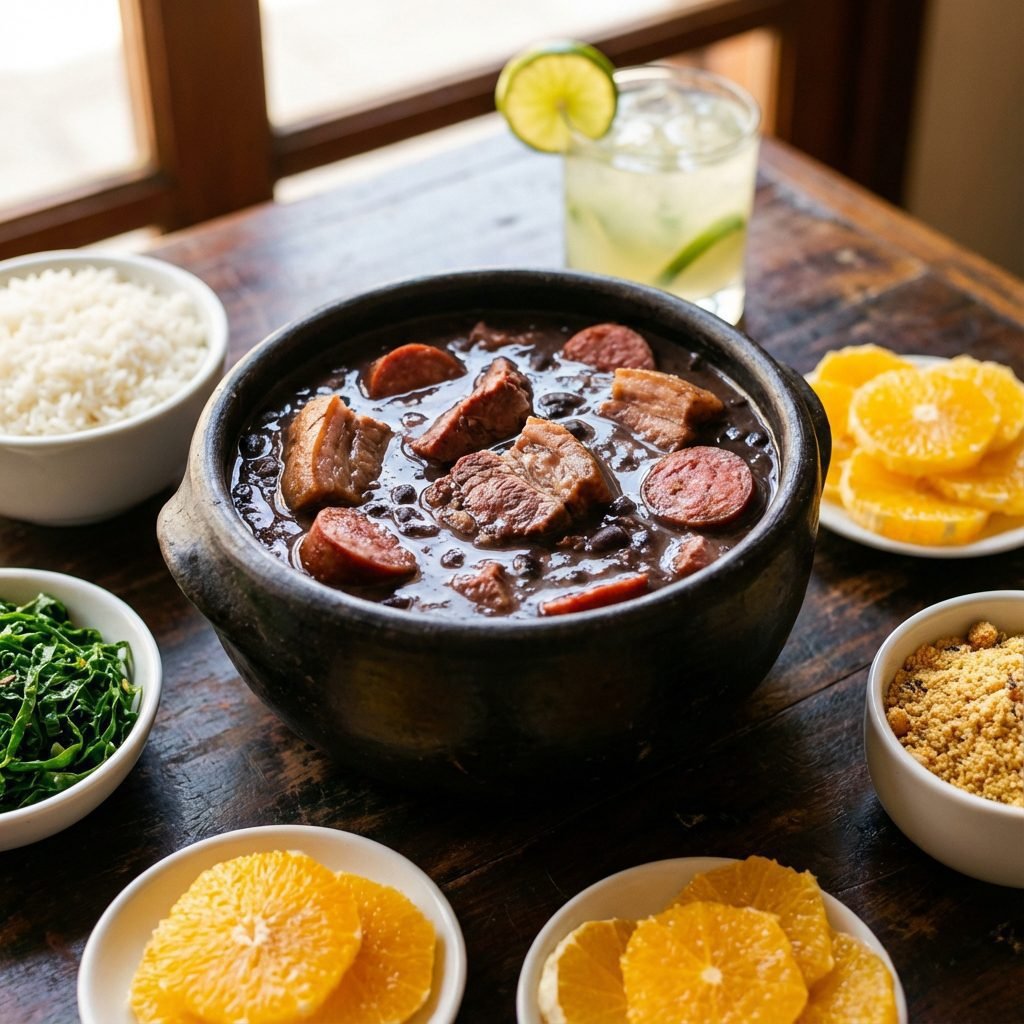
Feijoada: The Smoky Black Bean Stew That Feeds a Crowd for Pennies
Feijoada: The Smoky Black Bean Stew That Feeds A Crowd For Pennies
Welcome to the heart of Brazilian cuisine. Feijoada (pronounced fay-ZWAH-da) is more than just a dish; it’s a national celebration in a pot, a culinary event that brings friends and family together. This rich, smoky, and deeply satisfying black bean stew, studded with a variety of pork and beef cuts, is the undisputed national dish of Brazil. Its origins are debated, with some tracing it back to the food of enslaved people who ingeniously combined leftover pork scraps with the humble black bean, while others see European influences. Regardless of its history, its status is legendary. What makes Feijoada truly special is its ability to be both a luxurious feast and an incredibly economical meal. By using tougher, less expensive cuts of meat and the power of dried beans, you can create a show-stopping meal that feeds a large group without breaking the bank. It’s a testament to the magic of slow cooking, where simple ingredients are transformed into something complex, soulful, and utterly delicious. This recipe will guide you through creating an authentic Feijoada experience, complete with all the traditional accompaniments that make it a true feast.
30 minutes (plus overnight soaking)
3 hours 30 minutes
4 hours (plus overnight soaking)
Serves 8-10
Main Course
Simmering, Slow-Cooking
Brazilian
High-Protein
Why You’ll Love This Recipe
- Authentic Brazilian Flavor: A deep dive into the rich, smoky taste of Brazil’s national dish.
- Extremely Budget-Friendly: Learn how to turn inexpensive cuts of meat and dried beans into a luxurious feast.
- Perfect for a Crowd: This recipe is designed to serve a large group, making it ideal for parties and family gatherings.
- A Complete Meal Experience: Includes instructions for the essential side dishes like farofa, couve, and molho a campanha.
- Slow-Cooked Perfection: A one-pot wonder that develops incredible depth of flavor over several hours.
Equipment You’ll Need
- Large heavy-bottomed pot or Dutch oven (at least 8 quarts)
- Large bowl (for soaking beans)
- Separate saucepan (for cooking rice)
- Large skillet (for sautéing greens and making farofa)
- Cutting board
- Chef’s knife
- Ladle
- Slotted spoon
Ingredients
- For the Feijoada (Bean Stew):
- 2 lbs dried black beans, picked over and rinsed
- 1 lb pork shoulder or boneless country-style ribs, cut into 1-inch cubes
- 1 lb smoked pork ribs, separated
- 1/2 lb salt pork or thick-cut bacon, cut into 1/2-inch pieces
- 1 lb linguiça or paio sausage (or other smoked sausage like kielbasa), sliced 1/2-inch thick
- 2 large yellow onions, chopped
- 8-10 cloves garlic, minced
- 4 bay leaves
- 2 tablespoons olive oil or lard
- Water or low-sodium beef broth, as needed
- Salt and freshly ground black pepper to taste
- For the Couve (Collard Greens):
- 2 large bunches of collard greens, stems removed and thinly sliced (chiffonade)
- 4 cloves garlic, thinly sliced
- 2 tablespoons olive oil
- Pinch of salt
- For the Farofa (Toasted Manioc Flour):
- 1 cup coarse manioc flour (farinha de mandioca)
- 4 tablespoons butter or bacon fat
- 1/2 small onion, finely chopped
- Salt and pepper to taste
- For Serving:
- Cooked white rice
- Orange slices
Instructions
- Step 1: Prepare the Beans and Meats (The Night Before)
- Place the rinsed black beans in a large bowl and cover with cold water by at least 3 inches. Let them soak overnight. If using traditional salted meats like carne seca, they should also be soaked in a separate bowl, changing the water several times to desalinate.
- Step 2: Start the Stew Base
- The next day, drain and rinse the soaked beans. In your large Dutch oven or heavy-bottomed pot, heat the olive oil or lard over medium-high heat. Add the salt pork or bacon and cook until the fat has rendered and the pieces are crispy, about 5-7 minutes. Remove with a slotted spoon and set aside, leaving the rendered fat in the pot.
- Step 3: Brown the Meats
- Add the fresh pork shoulder cubes to the pot. Season with a little salt and pepper and brown on all sides. You may need to do this in batches to avoid overcrowding the pot. Remove the browned pork and set aside.
- Step 4: Sauté the Aromatics
- Reduce the heat to medium. Add the chopped onions to the pot and cook, stirring occasionally, until softened and translucent, about 8-10 minutes. Add the minced garlic and cook for another minute until fragrant.
- Step 5: Assemble the Feijoada
- Return the browned pork shoulder and crispy salt pork to the pot. Add the drained black beans, smoked pork ribs, and bay leaves. Pour in enough water or beef broth to cover all ingredients by about 2 inches. Bring the mixture to a boil, then reduce the heat to a low simmer.
- Step 6: The Long Simmer
- Cover the pot and let the feijoada simmer gently for at least 2 hours, stirring occasionally to prevent sticking. The beans should be tender and the meats should be starting to fall apart.
- Step 7: Add the Sausage and Finish Cooking
- After 2 hours, stir in the sliced linguiça or other smoked sausage. Continue to simmer, partially covered, for another hour. This allows the stew to thicken and the flavors to meld completely. If the stew becomes too thick, add a splash of hot water or broth. The final consistency should be a creamy, thick gravy, not watery.
- Step 8: Prepare the Sides (While the Stew Finishes)
- While the feijoada is in its final hour of simmering, prepare the accompaniments. Cook the white rice according to package directions. For the couve, heat olive oil in a large skillet over medium heat, add the sliced garlic and cook until fragrant. Add the sliced collard greens and a pinch of salt, and sauté quickly for just 2-3 minutes until wilted but still bright green. For the farofa, melt the butter or bacon fat in a skillet over medium heat. Add the onion and cook until soft. Gradually stir in the manioc flour and cook, stirring constantly, for 3-5 minutes until it is lightly toasted and fragrant. Season with salt and pepper.
- Step 9: Final Seasoning and Serving
- Once the feijoada is done, remove the bay leaves. Taste the stew and adjust seasoning with salt and pepper. Be cautious with salt, as the cured meats will have added a lot. To serve, ladle the feijoada into bowls. Serve alongside separate dishes of white rice, sautéed couve, farofa, and fresh orange slices.
Expert Cooking Tips
- Don’t Skip the Soak: Soaking the beans overnight is crucial for achieving a creamy texture and reducing cooking time.
- Low and Slow is Key: Do not rush the simmering process. The long, slow cook time is what breaks down the meats and melds the flavors into something magical.
- Skim the Fat: During the long simmer, you may notice fat rising to the surface. Feel free to skim some of it off with a ladle for a slightly leaner (but still rich) final product.
- Taste Before Salting: The various cured and smoked meats add a significant amount of salt to the stew. Wait until the end of the cooking process to taste and add any additional salt.
- Mash Some Beans: For a naturally thicker, creamier stew, take a cup of beans from the pot towards the end of cooking, mash them with a fork, and stir them back in.
Substitutions and Variations
The beauty of Feijoada is its flexibility. If you can’t find specific Brazilian sausages like linguiça or paio, you can substitute high-quality smoked Polish kielbasa, Spanish chorizo (the cured, not fresh kind), or andouille sausage. A smoked ham hock can be used in place of or in addition to smoked ribs for deep, smoky flavor. For the fresh pork, beef chuck roast cut into cubes is an excellent substitute for pork shoulder.
Common Mistakes to Avoid
The most common mistake is not properly desalting the traditional cured meats, which can make the entire dish inedibly salty. If using meats packed in salt, soak them for up to 24 hours, changing the water every few hours. Another mistake is rushing the cooking. Feijoada cannot be rushed; its flavor develops slowly. Finally, don’t forget the accompaniments. Serving Feijoada without rice, farofa, couve, and orange slices is like serving a burger without a bun – it’s just not the complete experience.
Serving Suggestions
Feijoada is traditionally served deconstructed. Place the large pot of stew on the table or a buffet line. Provide large bowls for guests. Arrange the side dishes in separate serving bowls: fluffy white rice, vibrant green sautéed couve, crunchy golden farofa, and a plate of bright orange slices. Guests build their own bowl, typically starting with a base of rice, then ladling the feijoada over top, and garnishing with couve and a sprinkle of farofa. The orange slices are eaten between bites to cleanse the palate and cut through the richness of the stew. For a truly authentic Brazilian gathering, serve with a pitcher of caipirinhas, Brazil’s national cocktail.
Storage and Reheating Tips
Feijoada is one of those magical dishes that tastes even better the next day. Allow the stew to cool completely before transferring it to an airtight container. It can be stored in the refrigerator for up to 4 days. Reheat gently on the stovetop over low heat, adding a splash of water or broth if it has thickened too much. The stew also freezes beautifully for up to 3 months. Store the side dishes separately.
Nutrition Facts (Estimated)
| Serving Size | 1 serving (approx. 1.5 cups stew, without sides) |
| Calories | 780 kcal |
| Fat | 45g |
| Saturated Fat | 16g |
| Unsaturated Fat | 29g |
| Trans Fat | 0g |
| Cholesterol | 130mg |
| Sodium | 1250mg |
| Carbohydrates | 48g |
| Fiber | 15g |
| Sugar | 4g |
| Protein | 42g |
Frequently Asked Questions
Can I make Feijoada in a slow cooker?
Yes, absolutely. After browning the meats and sautéing the aromatics on the stovetop (Steps 2-4), transfer everything to a large slow cooker. Cook on low for 8-10 hours or on high for 4-5 hours. Add the sausage during the last hour of cooking.
Do I need to use all the different types of meat?
No, you don’t. While a variety of meats adds complexity, you can make a delicious version with just one or two types. A good starting point would be pork shoulder and a quality smoked sausage. The key is to have a mix of fresh and smoked/cured meat for depth of flavor.
Is Feijoada gluten-free?
Yes, the stew itself is naturally gluten-free. All the traditional accompaniments—rice, collard greens, farofa (which is made from manioc root), and oranges—are also gluten-free. Just be sure to check the ingredients of your specific sausages to ensure they do not contain any gluten fillers.
Conclusion
Creating a pot of Feijoada is an act of patience and love. It’s a weekend project that fills your home with an intoxicating, smoky aroma and results in a meal that is profoundly comforting and celebratory. Every spoonful is a journey through savory, smoky, and earthy flavors, perfectly balanced by the fresh, bright accompaniments. Whether you’re a seasoned cook or a curious beginner, this recipe empowers you to bring the soulful spirit of Brazil into your own kitchen. Gather your friends, clear your afternoon, and get ready to enjoy one of the world’s great culinary experiences.