Better Than Texas Roadhouse Chicken Fried Steak With White Gravy
Better Than Texas Roadhouse Chicken Fried Steak With White Gravy
Welcome to the ultimate comfort food experience. Chicken Fried Steak is a cornerstone of Southern American cuisine, a dish that promises crispy, savory satisfaction with every bite. While many have tried the famous version at Texas Roadhouse, we’re here to show you how to create a version that’s not just as good, but definitively better, right in your own kitchen. This recipe focuses on two key elements: an impossibly crispy, well-seasoned crust that clings perfectly to the tenderized steak, and a rich, peppery white country gravy that’s smooth, creamy, and packed with flavor. Forget the restaurant lines and create a memorable, hearty meal that will have everyone asking for seconds.
25 minutes
20 minutes
45 minutes
4 servings
Main Course
Pan-Frying
American (Southern)
Comfort Food
Why You’ll Love This Recipe
- Achieves a perfectly crispy, golden-brown crust that won’t fall off.
- Features a rich, lump-free white pepper gravy made from scratch.
- Uses simple, accessible ingredients for a restaurant-quality meal.
- Provides detailed, step-by-step instructions suitable for all skill levels.
- A true Southern comfort classic, perfect for family dinners.
Equipment You’ll Need
- Large cast-iron skillet (12-inch recommended)
- Meat tenderizer or mallet
- 3 shallow dishes or pie plates for dredging
- Tongs
- Whisk
- Wire cooling rack
- Paper towels
Ingredients
- For the Chicken Fried Steak:
- 4 (4-6 ounce) cube steaks, about 1/2-inch thick
- 2 cups all-purpose flour
- 2 teaspoons kosher salt
- 2 teaspoons freshly cracked black pepper
- 1 teaspoon garlic powder
- 1 teaspoon onion powder
- 1 teaspoon smoked paprika
- 2 large eggs
- 1/2 cup whole milk or buttermilk
- 1 cup vegetable oil or shortening, for frying
- For the Creamy White Gravy:
- 1/4 cup pan drippings (add butter to make up the difference if needed)
- 1/4 cup all-purpose flour
- 3 cups whole milk
- 1/2 teaspoon kosher salt, or to taste
- 1 teaspoon freshly cracked black pepper, or more to taste
Instructions
- Step 1: Prepare the Steaks. Place the cube steaks between two sheets of plastic wrap. Using a meat mallet, gently pound the steaks to an even thickness of about 1/4 inch. This step ensures they cook quickly and remain tender.
- Step 2: Set Up Dredging Station. You will need three shallow dishes. In the first dish, combine 2 cups of flour with the salt, pepper, garlic powder, onion powder, and paprika. Whisk until well combined. In the second dish, whisk together the eggs and 1/2 cup of milk until smooth. Leave the third dish empty for now.
- Step 3: Double Dredge for Maximum Crispiness. Take one steak and dredge it thoroughly in the seasoned flour mixture, shaking off the excess. Next, dip it into the egg wash, ensuring it’s fully coated. Finally, place it back into the seasoned flour for a second, heavy coating. Press the flour firmly onto the steak to help the crust adhere. Place the coated steak on a clean plate or wire rack and repeat with the remaining steaks. Let them rest for 5-10 minutes to allow the coating to set.
- Step 4: Heat the Oil. Pour the vegetable oil into a large cast-iron skillet to a depth of about 1/2 inch. Heat over medium-high heat until the oil reaches 350°F (175°C). If you don’t have a thermometer, a pinch of flour should sizzle immediately when dropped in.
- Step 5: Fry the Steaks. Carefully place two steaks into the hot oil, being careful not to overcrowd the pan. Fry for 3-4 minutes per side, until the crust is a deep golden brown and the steak is cooked through. Use tongs to flip them only once to avoid disturbing the crust.
- Step 6: Drain the Steaks. Remove the cooked steaks from the skillet and place them on a wire rack set over a baking sheet to drain. This keeps the bottom from getting soggy. Repeat the frying process with the remaining two steaks.
- Step 7: Start the Gravy. Carefully pour off all but about 1/4 cup of the hot oil and drippings from the skillet (be mindful of any burnt bits, discard those). Return the skillet to medium heat.
- Step 8: Make the Roux. Sprinkle the 1/4 cup of flour into the hot drippings. Whisk constantly for about 1-2 minutes until a smooth, light brown paste (a roux) forms. This cooks out the raw flour taste.
- Step 9: Whisk in the Milk. While whisking continuously, slowly pour in the whole milk. Continue to whisk vigorously to prevent lumps. Bring the gravy to a simmer, and it will begin to thicken.
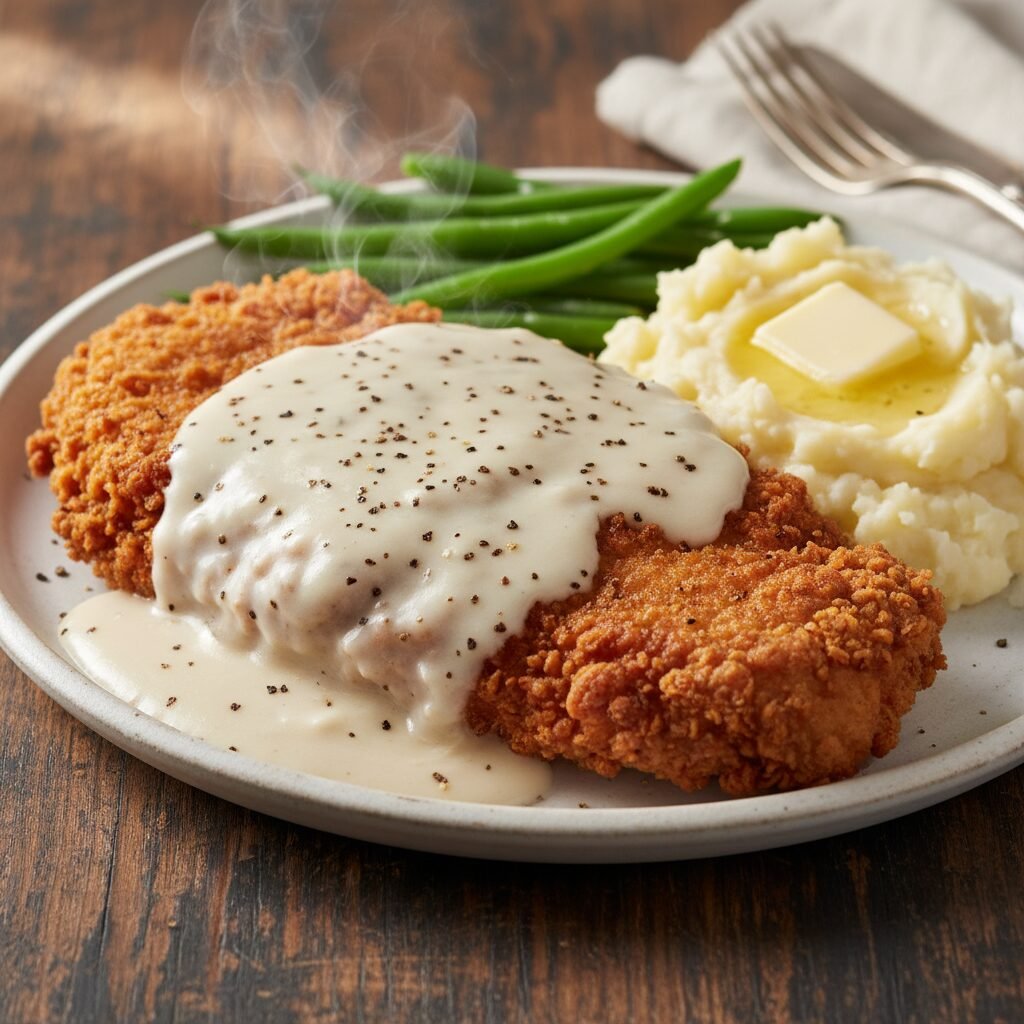
- Step 10: Season and Serve. Continue simmering for 3-5 minutes, or until the gravy has reached your desired consistency. Season generously with salt and a lot of black pepper. Taste and adjust seasoning as needed. To serve, place a warm chicken fried steak on a plate and ladle a generous amount of the creamy white gravy over the top.
Expert Cooking Tips
- Use a Cast-Iron Skillet: It retains heat exceptionally well, which is crucial for maintaining the oil temperature and achieving a perfectly crispy crust.
- Don’t Skip the Double Dredge: The flour-egg-flour method is the secret to a thick, craggy crust that stays on the steak.
- Monitor Oil Temperature: If the oil is too cool, the steak will absorb it and become greasy. If it’s too hot, the crust will burn before the steak is cooked. 350°F is the sweet spot.
- Rest the Breaded Steak: Letting the coated steaks rest for a few minutes helps the breading ‘set’ and adhere better during frying.
- Whisk Vigorously for Gravy: To ensure a smooth, lump-free gravy, add the milk gradually and never stop whisking until it’s fully incorporated and simmering.
Substitutions and Variations
For the steak, you can use top round or sirloin steak that you tenderize yourself. Buttermilk can be used in place of whole milk in the egg wash for extra tang and tenderness. For a gluten-free version, a high-quality, all-purpose gluten-free flour blend can be substituted, though the texture of the crust may vary slightly.
Common Mistakes to Avoid
Soggy Crust: This is usually caused by the oil not being hot enough or overcrowding the pan, which drops the oil’s temperature. Fry in batches to ensure each steak has enough space. Breading Falls Off: This can happen if you don’t press the flour firmly onto the steak during the final dredging step or if you move the steak around too much while it’s frying. Flip it only once. Lumpy Gravy: This occurs when the milk is added too quickly to the roux. Pour the milk in a slow, steady stream while whisking constantly to ensure a silky-smooth consistency.
Serving Suggestions
Chicken Fried Steak is traditionally served with a generous portion of creamy mashed potatoes, which act as the perfect vessel for extra gravy. Other classic sides include sautéed green beans, buttered corn, collard greens, or a simple side salad. Don’t forget the buttermilk biscuits or cornbread to sop up every last drop of the delicious gravy.
Storage and Reheating Tips
Store leftover chicken fried steak and gravy in separate airtight containers in the refrigerator for up to 3 days. For best results when reheating, place the steak on a baking sheet in a 375°F (190°C) oven or in an air fryer for 5-10 minutes until heated through and crispy. The gravy can be gently reheated in a saucepan over low heat; whisk in a splash of milk if it has become too thick.
Nutrition Facts (Estimated)
| Serving Size | 1 steak with gravy |
| Calories | 875 kcal |
| Fat | 58g |
| Saturated Fat | 22g |
| Unsaturated Fat | 36g |
| Trans Fat | 0g |
| Cholesterol | 160mg |
| Sodium | 1250mg |
| Carbohydrates | 46g |
| Fiber | 2g |
| Sugar | 5g |
| Protein | 42g |
Frequently Asked Questions
Can I use a different cut of meat besides cube steak?
Yes, you can. Top round or sirloin are good alternatives. You will need to tenderize them thoroughly with a meat mallet, pounding them to about a 1/4-inch thickness before breading.
Is it necessary to use a cast-iron skillet?
While not strictly necessary, a cast-iron skillet is highly recommended. Its superior heat retention and distribution help maintain a consistent oil temperature, which is key to a perfectly fried, non-greasy crust.
My gravy is too thin/thick. How can I fix it?
If your gravy is too thin, let it simmer for a few more minutes, as it will thicken over time. If it’s still not thick enough, you can make a small slurry of 1 tablespoon of cornstarch and 2 tablespoons of cold water and whisk it in. If the gravy is too thick, simply whisk in a little more milk until it reaches your desired consistency.
Conclusion
There you have it—a chicken fried steak recipe that rivals, and even surpasses, the beloved restaurant classic. With its ultra-crispy crust and a velvety, peppery gravy, this dish is the embodiment of comfort and culinary satisfaction. It’s a testament to the fact that the best meals are often made with simple ingredients and a little bit of love. Gather your family, set the table, and prepare for a chorus of praise.